 Featured on

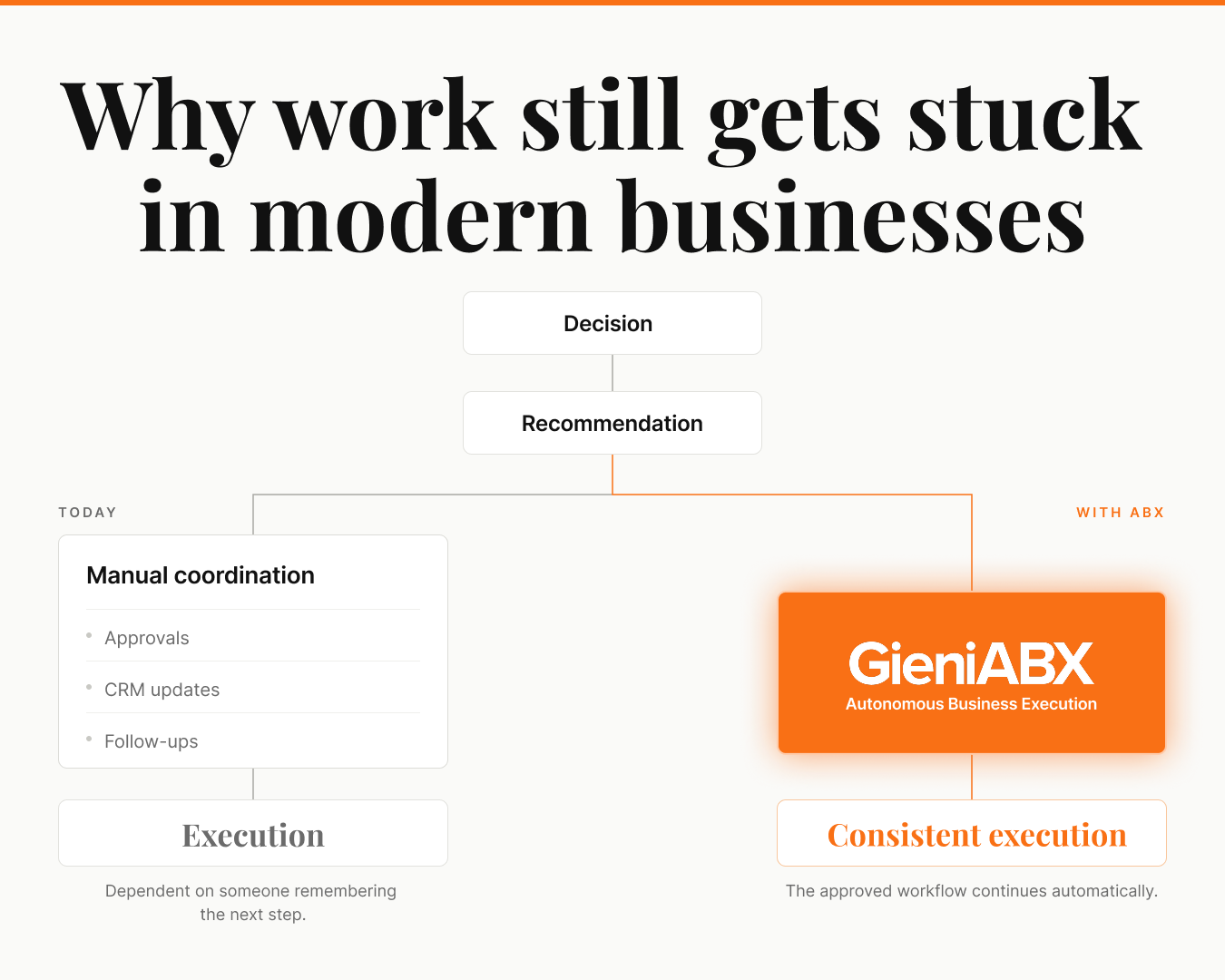
Most organisations don't struggle because they lack information.
Sales teams know which opportunities deserve attention. Managers can quickly see outstanding approvals, while project dashboards make it easy to identify work that's falling behind. Businesses have never had more visibility into what needs to happen next.
Even so, work still slows down.
Every decision has to make its way through the organisation before it creates an outcome. A customer enquiry becomes a sales opportunity, a proposal moves through an approval process and a contract passes between legal, finance and sales before reaching the customer. Along the way, work moves between people, departments and systems, each relying on the previous step before it can continue.
Most of those individual tasks only take a few minutes.
The delays appear in the gaps between them. A follow-up waits until tomorrow because another meeting overruns, an approval sits in someone's inbox while they're travelling and a customer record remains incomplete because attention has already shifted to the next opportunity.
None of those delays seems significant on its own.
Together, they become the reason work slows down.
This is the Execution Gap.
What is the Execution Gap?
The Execution Gap is the space between making a decision and seeing that decision carried through consistently.
Every organisation depends on business processes that move work from one stage to the next. New leads need qualifying before they become opportunities, customer requests pass through multiple teams before they're resolved and purchase orders require approvals before projects can continue.
None of these activities is especially complicated on its own.
Keeping them moving consistently is where the challenge begins.
As organisations grow, more people become involved, business rules become increasingly detailed and work flows across a larger number of systems. Every additional handover introduces another opportunity for momentum to slow, making consistent execution harder to maintain even when teams are working hard.
Why work still gets stuck
Most organisations already have the software they need.
Sales teams work in Salesforce or another CRM. Projects are managed through dedicated platforms, while customer support, finance and operations each rely on specialised systems. AI assistants make it easier to draft emails, summarise meetings and analyse information in seconds.
Each of these tools solves an important problem.
Together, they improve visibility, communication and decision-making across the business.
What they don't guarantee is that work continues automatically once a decision has been made.
After a customer meeting, someone still needs to update the CRM, assign ownership, schedule follow-up activities and make sure the appropriate teams have been notified. Multiply those responsibilities across hundreds of customers, projects and internal processes, and it's easy to see how delays begin to accumulate.
Most organisations already know what should happen next.
The challenge is ensuring those decisions are carried through consistently without relying on manual coordination.
Why more technology hasn't solved it
For years, businesses have responded to operational challenges by introducing another tool.
New dashboards improve visibility, AI assistants produce better content in less time and analytics highlight opportunities that might otherwise go unnoticed.
Each of those technologies adds value.
None of them ensures that approved work continues through the organisation.
Work begins to slow in subtle ways. An opportunity remains untouched after a successful sales meeting, a customer waits longer than expected because an internal handover hasn't happened and an approval delays the next stage of a process while it sits in someone's inbox. Individually, those moments seem minor. Collectively, they create operational friction across the business.
The challenge begins once a decision has been made and work needs to move through the organisation. At that point, progress often depends on people manually carrying work from one step to the next.
Closing the Execution Gap
Closing the Execution Gap requires more than visibility into what's happening.
It requires execution.
Autonomous Business Execution (ABX) executes approved business processes according to business rules defined by the organisation. It carries work forward automatically, without relying on someone to remember the next action, while keeping people responsible for the decisions that require judgement and experience.
Imagine a customer requests a product demonstration.
The request is received, the CRM is updated, follow-up activities are generated and the appropriate teams are notified according to the organisation's workflow. Each approved step continues automatically, allowing employees to focus on the customer rather than coordinating routine administration.
Execution becomes part of the operating model rather than another manual responsibility.
Why execution is becoming a competitive advantage
Growth has always created complexity.
As organisations expand, more customers, more employees and more systems naturally create more operational work. Traditionally, businesses have responded by hiring additional people to keep everything moving.
Autonomous Business Execution offers another way to scale.
When approved business processes execute consistently, organisations create the capacity to handle more work without increasing headcount. Employees spend less time updating systems, chasing approvals and coordinating routine activities, giving them more time to build customer relationships, solve complex problems and make better decisions.
Salespeople create value by building relationships with customers, not by spending hours updating CRM records. In the same way, operations teams deliver their greatest impact when they're improving processes rather than checking whether work has moved to the next stage or following up on outstanding approvals.
Reducing that operational friction allows people to spend more of their time on the work they were actually hired to do.
That's where execution becomes a competitive advantage.
Looking ahead
Artificial intelligence has transformed how organisations access information, generate ideas and support decision-making.
The next challenge is ensuring work continues once those decisions have already been made.
Closing the Execution Gap means building organisations where approved business processes execute consistently, operational overhead is reduced and people remain responsible for the decisions that require experience and judgement.
Gieni ABX executes approved business processes according to your business rules, keeping work moving across your organisation while reducing unnecessary coordination.