 Featured on

Artificial intelligence, including autonomous AI systems, has changed how businesses work. It can write emails, analyse data, summarise meetings and answer questions in seconds.
Despite those advances, one challenge remains the same: work still depends on people to keep it moving.
Sales teams update the CRM, managers approve requests, and someone always needs to assign the next task or follow up with a customer. As organisations grow, that coordination becomes increasingly difficult. More systems, more people and more handoffs mean that work often slows down, even when everyone knows what needs to happen.
Autonomous Business Execution (ABX) was built to solve that problem.
What is Autonomous Business Execution?
Autonomous Business Execution is a category of software designed to execute business processes.
Businesses define the objectives, the rules and the approval boundaries. ABX carries work forward within those parameters, allowing approved processes to continue without constant manual coordination.
The focus is execution. ABX executes approved work across business processes while people remain responsible for decisions.
People generally like their actual work. Salespeople enjoy selling, customer success teams enjoy helping customers, operations teams enjoy solving problems. What frustrates them is everything around that work: updating CRM records, chasing approvals, moving information between systems, making sure the next task doesn't get forgotten. Those activities keep businesses running, but they also consume hours that could be spent creating value.
Why today's AI isn't enough
Most AI products improve productivity. They generate content, analyse information and recommend actions that help people work faster.
Those recommendations still need someone to act on them.
A sales opportunity has to be qualified. Customer information needs updating. Tasks must be assigned, approvals completed and follow-ups scheduled. Each activity may only take a few minutes, but together they create operational overhead that grows with the business.
Many organisations don't struggle because they lack information. They struggle because of the execution gap: execution depends on dozens of manual steps spread across different systems and teams.
How ABX is different
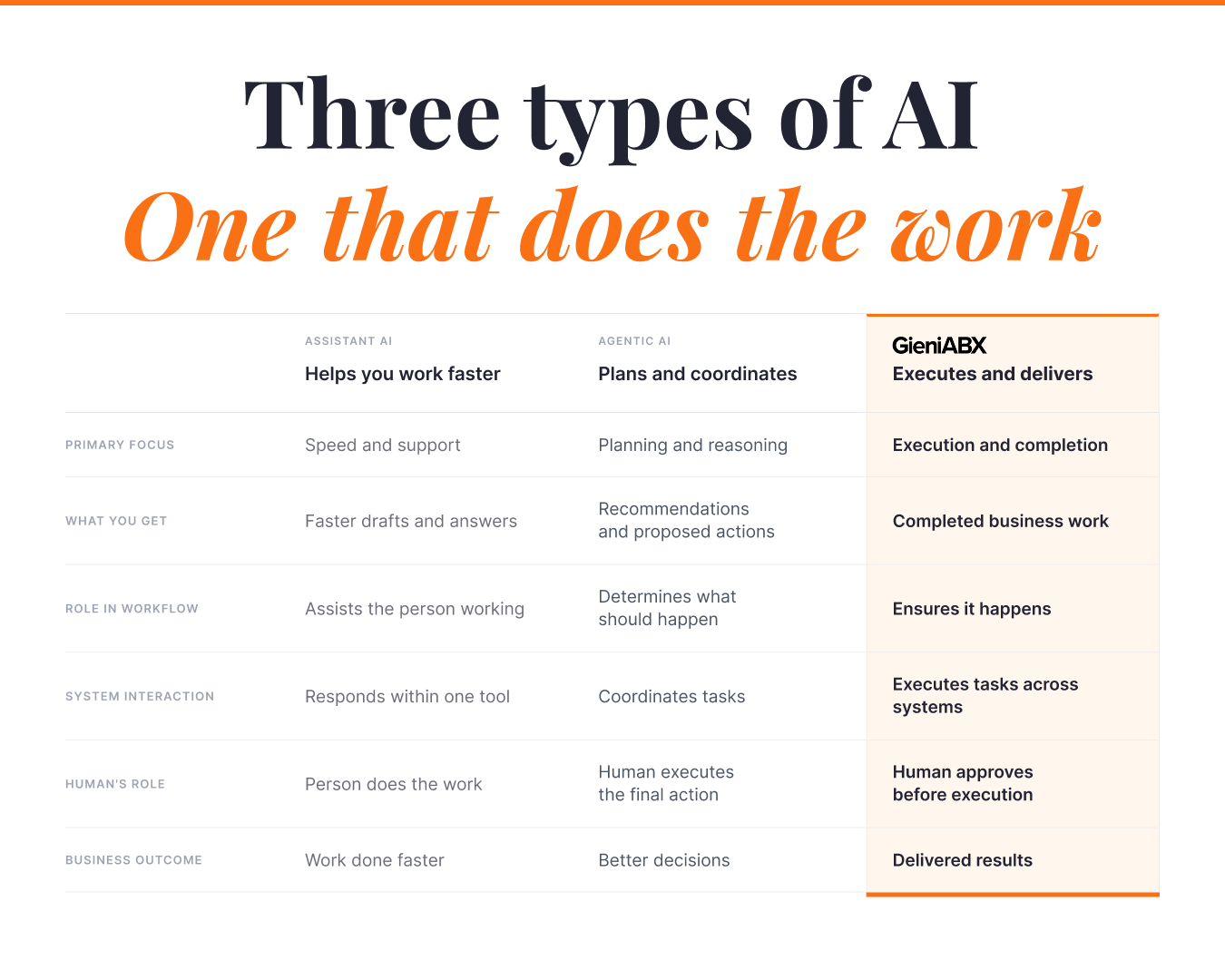
Enterprise AI now includes several categories, each designed for different types of work. Assistant AI focuses on generating content and answering questions. Agentic AI coordinates goals and plans multi-step actions. Autonomous Business Execution belongs to a different category. Its purpose is to execute approved business processes according to business rules.
For a deeper comparison, see Agentic AI vs. Autonomous Business Execution.
Why execution matters
Every growing company reaches a point where coordination becomes the bottleneck.
As teams expand, meetings increase, follow-ups become routine and administrative work grows alongside the business. Valuable time is spent keeping processes moving instead of improving customer relationships or delivering strategic work.
Autonomous Business Execution reduces that operational overhead by allowing routine processes to continue automatically within defined business rules. Teams spend less time coordinating work and more time focusing on outcomes.
What businesses gain
As organisations grow, the amount of operational work grows with them. Customer enquiries increase, approvals multiply and more information has to move between people and systems. Traditionally, businesses respond by hiring more people to keep work moving. Autonomous Business Execution offers a different approach. By executing approved business processes consistently, organisations can increase the amount of work they handle without increasing headcount, allowing employees to spend more time on the work that benefits from their experience and judgement.
People remain responsible for business decisions. ABX takes responsibility for executing approved processes.
A practical example
A customer requests a product demonstration.
In many organisations, someone manually creates the opportunity, updates the CRM, assigns follow-up activities and makes sure the next actions happen on time. Every handoff creates another opportunity for delays.
With Autonomous Business Execution, the approved workflow continues automatically. The CRM is updated, tasks are assigned, the right people are notified and the process keeps moving according to predefined business rules.
Execution no longer depends on someone remembering the next step.
Where ABX fits
Businesses already have systems that store information. They also have AI tools that generate information.
The next challenge is ensuring work moves consistently across those systems.
Autonomous Business Execution gives organisations a way to execute business processes with greater consistency, reduce coordination overhead and maintain accountability while people stay in control of business decisions.
Ready to see ABX in action?
Autonomous Business Execution changes how work gets done, executing approved business processes consistently and at scale.
If you'd like to see how Gieni ABX works in practice, book a demo with our team and discover how Autonomous Business Execution keeps your organisation's work moving.